Arrests of kidnappers, Otasowie’s murderers justify Obaseki’s call for New CP – Edo Govt. Arrests of kidnappers, Otasowie’s murderers justify Obaseki’s call for New CP – Edo Govt. ON OCTOBER 27, 20173:58 PMIN NEWSCOMMENTS The Edo State Government has said that the recent arrests by the State Police Command of seven persons in connection with the murder of Prof. Paul Otasowie, a lecturer with the University of Benin, killers of three police officers who also kidnapped Andy Ehanire, the Chief Executive of Ogba Zoological Garden, justify Obaseki’s insistence on a new commissioner of police for the state. Governor Godwin Obaseki of Edo State (right) and the new Edo State Commissioner of Police (CP), Johnson Babatunde Kokumo, at the Government House in Benin City on Wednesday, October 25, 2017. While commending the new Commissioner of Police, Johnson Kokumo, the state government, through the Special Adviser, Media and Communication Strategy to the Edo State Governor, Crusoe Osagie, stated that the security challenges in Edo required a highly experienced operational police officer at the helms of affairs and that it is quite gratifying that CP Kokuma has since hit the ground running, “a result of which is the large hurl of arrests in barely 48 hours of his assumption of duty in Edo State”. Otasowie, a senior lecturer in the Department of Electrical and Electronics Engineering, was on October 4 killed by gunmen in Ekehuan area, in Oredo Local Government Area of the state. The deceased, who was the Director of the institution’s Student Industrial Work Experience Scheme, was said to have been shot in front of his residence. The police explained that seven out of those principally responsible for the killing have been arrested and each has given useful statement to the police. The police further stated that four suspects in the murder of three police officers and the kidnap of Ehanire of have been arrested. The police, through Moses Mkombe, the force public relations officers, said that the command is still on a manhunt for the rest other members of the group. “Each of them has spoken on the role he played in the crime and we have been able to extract useful information from them. We are currently on a manhunt for the other members of the gang,” Mkombe said.Governor Godwin Obaseki of Edo State (right) and the new Edo State Commissioner of Police (CP), Johnson Babatunde Kokumo, at the Government House in Benin City on Wednesday, October 25, 2017.
Governor Godwin Obaseki of Edo State (right) and the new Edo State Commissioner of Police (CP), Johnson Babatunde Kokumo, at the Government House in Benin City on Wednesday, October 25, 2017
THE REAL EDO STATE
Saturday, 28 October 2017
Wednesday, 25 October 2017
| The world is too small to handle when we are ready to Shear responsibilities???? |
You are going to follow ME on my blog and share in my ideals
When a single talented person is placed at the top as the head, all the untalented would be well cared for.
When the government of the day knows his people and their profession, they will be able to turn the wheel of economy in the sense that the little fund in system can be rolled among citizens.
When a single talented person is placed at the top as the head, all the untalented would be well cared for.
When the government of the day knows his people and their profession, they will be able to turn the wheel of economy in the sense that the little fund in system can be rolled among citizens.
I CAN REALLY CHANGE THIS WORLD
It has long been said that if you want to change the world, you start from your bedroom
THEN I CAN CHANGE EDO STATE, NIGERIA AND EVEN THE WORLD TOO.
Sunday, 12 October 2014
Armed thugs invade Edo lawmakers quarters
October 12, 2014 by Alexander Okere
•The
Edo State House of Assembly quarters and the vandalised cars after the
attack on Saturday. Photos: Edo State Government House
Hoodlums
on Saturday morning attacked the legislative quarters of the Edo State
House of Assembly in Benin, vandalising property worth millions of
naira.
The action deepened the crisis in the
state assembly.Our correspondent gathered that the armed hoodlums,
numbering over 100, forced their way into the premises located at Iyama
Road of the city at about 6:30am, after overpowering the security
personnel at the entrance.
The attack caused the occupants to
scamper to safety. When our correspondent got to the scene, some of the
windows of the apartments were shattered while bullet holes were seen on
some of the vehicles and doors.
The Edo State Governor, Adams Oshiomhole,
who arrived at the scene of the incident at about 11am, was conducted
round the quarters by the Speaker, Uyi Igbe, condemned the attack on the
lawmakers and their family members.
The governor also accused the Peoples Democratic Party of masterminding the mayhem.
He also took a swipe at the police, alleging that they “granted permission” for the attack.
Addressing newsmen after the inspection,
Oshiomhole said, “The PDP leaders had a meeting where it was decided
that thugs should be recruited to come and perpetrate this attack.
“It is very clear that the police granted
permission for this attack because the Commissioner of Police was
informed at about 10:00pm last night of the plan of the PDP to attack
the legislative quarters and the APC office.
“We made this intelligence available to
the commissioner of police and what we then saw was that even the
minimal police presence here was vacated so that these thugs could come
and have a free reign of terror. It was conveyed to the CP last night
that they were going to assemble at George Idah Primary School.”
He added, “They actually assembled at
George Idah Primary School this morning before they proceeded and the
police provided supervision for this very serious criminal act. It is
very clear that the police command leadership granted permission to the
PDP to carry out this heinous crime.”
The governor also lamented that the PDP
in the state, sought to make the state ungovernable, rather than share
the concern of President Goodluck Jonathan, who is a member of the
party, to address the challenges of insurgency in the country.
He said, “I think for all Nigerians, at a
time when we are confronted by insurgency and other forms of violent
crime, one will expect that any functionary of the other party will
share the concern of the President on peace and security.
“Some of the PDP leaders in Edo State
having lost out and rejected by the people believe that they can create a
situation that will make Edo State ungovernable and create complete
distraction in their futile calculation that they can remove themselves
from power.
“This is a very dangerous thing. I am not
so much worried about the violent character of the PDP, I am more
worried by what seems to be the police readiness to provide them with
cover.”
Oshiomhole, while warning the major
opposition party in the state, said, “Power is very transient,” gave the
assurance that his administration would not be distracted from its
constitutional duty of governance.
He said, “My warning to PDP is that power
is very transient. Today you are in power, tomorrow you are out of
power. Any crime you have committed and the present political order
covers you, when the order changes, you will report to justice.
“Yesterday (Friday) at the airport, the
President came and, in line with my conviction that he is the President
of Nigeria and not of a particular party, I went to receive him. When he
was here two weeks ago to address a rally, I went to the airport to
receive him. For me, that is the idea of politics. It is not war. It
should not be so primitive.
“Yesterday (Friday) again, I went to the
airport to receive the President for the ground breaking ceremony of a
private sector investment which we jointly midwifed with over $800
million. This same Pastor Ize-Iyamu organised rascals and they were
abusing themselves.”
But the leadership of the Edo State PDP,
while briefing journalists in Benin on Saturday, dismissed the
allegations that the party masterminded the attack at the premises of
the lawmakers.
The State Chairman of the party, Mr. Dan
Orbih, debunked the claim that a meeting was held late on Friday night
where they hatched the plot.
He said that the only activity conducted on Friday was to welcome the President to the state.
Orbih said, “There is no truth whatsoever
in the governor’s allegations. After welcoming Mr. President to Edo
State on Friday, many of us went to our houses, had a light dinner and
went to bed.
“It is common knowledge that what
happened might have been born out of the attack on Rasaq Momoh and the
fact that those accused are now free today. What happened this morning
was not the work of our party. We believe in the law enforcement
agencies to deal with the situation.”
While saying the police would not “join
issues with anybody,” the Edo State Commissioner of Police, Foluso
Adebanjo, told our correspondent on telephone that the state command had
arrested 12 persons in connection with the Saturday attack.
He also claimed that the vehicle
purportedly used to convey the attackers had been recovered, adding that
more arrests would be made.
“We do not want to join issues with
anybody. All I can say is that we have arrested about 12 and we have
recovered the vehicle that they used.”
“We are in a meeting now and we are going
to get more and more. We will not allow any lawlessness being
perpetrated by political gladiators,” Adebanjo said.
Chikungunya fever!
Dr. Sylvester Ikhisemojie
| credits: File copy
| credits: File copy
October 12, 2014 by Dr. Sylvester Ikhisemojie
The
world is in fear as a result of the Ebola virus disease that has evaded
all preventive measures and landed almost simultaneously in the United
States and Spain. The Liberian traveller to the US who developed the
disease several days after arriving in the state of Texas has now died.
This has happened despite having access to some of the finest healthcare
facilities on the planet. The patient in Spain is relatively more
stable but her dog, Escallibur, was euthanized after an unsuccessful
campaign by her now quarantined husband to stop it. The reason for that
move by the state was clear: it is known that pets like dogs and perhaps
cats are prone to developing the disease without having any symptoms.
It is not clear if they can transmit the disease to humans. That gap in
current knowledge should worry people. We are not allowed in the present
circumstances to assume things because that could be dangerous.
Preventive actions taken must be with an abundance of caution. Bats,
monkeys, gorillas, antelopes and porcupines are known now to be able to
transmit the disease. Perhaps, grass-cutters, dogs and cats may also be
able to do so. More frightfully, dogs may be able to do this without
showing any signs of this terrifying disease. Pet lovers, owners and
those who eat dogs need also to be particularly aware. What all these
demonstrate is that we are not out of the woods yet and so we must not
lower our guard. This is particularly so at a time when there is an
outbreak of the Marburg fever in Uganda and an out of control Ebola
epidemic in Liberia and Sierra Leone and to a lesser extent, in Guinea
and The Congo.
Enter now the bizarre mix of other viral
infections suddenly announcing their presence around the world. Of most
recent prominence is the Chikungunya virus which bears a striking
similarity to Dengue Fever. It is transmitted from one person to another
by the bite from a mosquito known as Aedes Egypti which is found in
most parts of the tropics. It has been found in parts of Africa, Asia,
Europe and the Americas. It is also seen in the Pacific and Indian
oceans. In recent weeks, it has made a troublesome appearance in the
Central American nations of Venezuela, Colombia and Nicaragua. Hundreds
of people have been sickened and this is an area of the world that has
never previously seen an outbreak. The original outbreak of this
sickness was in Tanzania in 1952 and it means “to bend painfully” or to
become “contorted”. It is not transmitted from one person to another
directly but through that mosquito vector. There have been reports of
more than a few cases in different parts of Nigeria. This infection is
established when a mosquito infected with the virus bites somebody who
has the infection and goes to bite another who does not have it thereby
transferring its infected saliva into such an individual much like it
happens when people contract malaria. Most of the bites occur during
daylight hours but the Aedis egypti is also known to bite people
indoors. There seems to be a peak in these bites in the early morning
hours and in the early part of the evening.
The common symptoms begin some two to
five days after an infection with a feverish phase and may last for up
to 12 days. Majority of those infected will develop symptoms among which
are fever, a reddish rash that can involve the trunk and the limbs as
well as the non-specific symptoms itemised below. It is known that
monkeys, cattle, birds and rodents are natural reservoirs of this
disease. The symptoms may include the following: a high grade fever of
sudden onset, conjunctivitis, headaches which are throbbing in character
and can be quite persistent, nausea and vomiting, severe joint and
muscle aches which are very debilitating, photophobia, loss of taste as
you might also see in malaria. Swelling of the legs may also occur and
it is not related to any kidney, heart or liver disease. However,
certain heart complications have been reported nevertheless.
The symptoms are usually mild amongst
young people and pregnant women. In elderly people aged more than 65
years, however, nearly a third of sufferers could die. Whether this is
due solely to advanced age or the more common illnesses associated with
age is unclear. What is known without a doubt is that the elderly people
fare a lot worse from this disease. Death from Chikungunya fever is
certainly rare but the debilitation it causes with lingering joint pains
and relative incapacitation can last for several months or even years.
The fever can greatly improve together with other symptoms within
sevenp- to 10 days.
Since 2004, Chikungunya fever has reached
epidemic proportions around the world. It is most likely to be
misdiagnosed also in the regions of the world where Dengue fever is
common. There is no known cure for this disease and there is no known
preventive vaccine available. Treatment consists of efforts to replenish
body fluids with intravenous fluids if they are vomiting or not eating,
the administration of antibiotics to deter bacteria which may want to
take advantage of the downgraded immune system and the use of analgesics
and anti-pyretics to control the fever. Cold baths can also be used in
this regard to help in controlling the fever. These are efforts in
essence to help the body combat the infection. Rest and sequestration
from other people is vital if there is going to be any chance of
recovery. There is also no vaccine for this disease.
This disease is diagnosed in the
laboratory with a blood test which can identify the virus or the
existence of antibiotics developed against the infection. These are the
usual ways by which a definitive diagnosis is made and treatment begun.
Treatment is supportive in nature and is by no means tailored to attain
cure. It is important at the point of diagnosis, to separate a sufferer
of this infection from other family members or other patients in a
health facility because they can be a risk to others around them if they
are bitten by the Aedes mosquito.
The preventive efforts must be geared
towards the reduction of the mosquito population, the elimination of
their breeding environment among old broken pots for example, old tyres,
the elimination of pools of stagnant water around the home. Those who
live in densely populated residential neighbourhoods are particularly at
risk because of the ability of the mosquito to navigate in such areas.
People who live in the rural areas are also not free even if their
population density is less. They should be appropriately dressed for the
outdoors whenever they are venturing outside. They should wear the
traditional wrapper which covers the woman well or as is increasingly
common, wear trousers much as the men are likely to do and the men
should also wear hats which help in providing extra protection outdoors.
This attitude to prevention will avail much. People should also not
fail to use mosquito netting on their doors and windows as well as
sleeping in insecticide-treated nets. Most importantly, it must be noted
here that like the other viral haemorrhagic fevers, this particular one
has no vaccine available and has no cure. Prevention of this infection
is therefore a key factor to control its spread and its possible
complications.
Ask the doctor
Dear doctor, I am a
38-year-old man and I caught my lady using Cytotec. She lost her period
for the month of September and I told her that I am ready for the baby.
Cytotec is for what?
070396xxxxx
Cytotec is a prostaglandin drug
that is used to control vaginal bleeding after childbirth, to induce
labour in women who are scheduled to deliver their babies on certain
dates and as a combination drug to prevent the development of stomach
ulcers in certain people on powerful pain killers. However, the school
girls also know about its usefulness to procure abortions. I suppose
that is the purpose for which your lady used it.
Dear doctor, I am having a swollen heart. What type of food should I be eating? It was shown on X-ray. I don’t want to die now.
090395xxxxx
A swollen heart as you have put it is a
very serious issue indeed. This is not a matter for food. It has to do
with your age and what disease you suffer from that may have predisposed
you to this complication, for it is a complication. You must see your
doctor for further examination and a possible referral to a cardiologist
for yet more tests and treatment. Do so without any further delay.
Dear doctor, I am a
28-year-old virgin. During my period in September, a painful tiny growth
developed on my vulva (labia minora to be specific) but this growth
regressed on its own four days after my period without any treatment.
Sir, what is this strange occurrence and how can it be prevented in the
future?
070577xxxxx
There is no way for me to be certain
about what that could have been. It ranges in possibility from a
Bartholin’s cyst (unlikely because this is usually a growth on the labia
majora) to a simple boil which can occur commonly. The fact that it
regressed on its own shows that it may not really be a problem other
than its nuisance value. However, you should see your doctor for this.
Dear doctor, I am suffering
from Staphylococcus and I have taken several injections but it has yet
to heal. My body gets hot with noises in my tummy. My penis also gets
weak after one round of sex. Please what is the best medicine for it?
080381xxxxx
You need to understand that
Staphylococcus is not a usual cause of disease. Therefore, you may be
taking drugs for the wrong reasons. The bacteria were found in what kind
of specimen? Urine, blood, swab or semen? If so, it is most likely to
be from some contamination rather than an infection because infection
from this organism is often very severe. As a result of all the above
reasons, there is no best medicine for this organism.
Dear doctor, I am a
68-year-old man. Whenever I go to bed between 9 and 10pm, I do not sleep
more than four hours except I take sleeping pills. What is the solution
to this? I am worried.
080225xxxxx
You did not say whether you also sleep
during the day. If that happens, it would explain why you sleep for such
a short period during the night. Generally, most people of your age
would probably sleep for brief periods at a time and do so several times
in a 24-hour-cycle. If that is true with you, there is no need to take
sleeping tablets which could damage you if you use them for a long time.
Dear doctor, is there
orthodox medicine for “jedi-jedi” in a baby less than a year? Please
kindly tell me because my baby has “jedi-jedi”.
080261xxxxx
I have some difficulty understanding what
you mean by “jedi-jedi” as I do believe you may be faced with something
a bit more serious than what is obvious now. There is orthodox medicine
for nearly every ailment described in the world. I believe you should
take your baby to see a paediatrician for detailed examination and the
correct prescription to treat your baby.
Dear doctor, I always have easy sperm release while having sex with a girl. What can I do about it?
0803506xxxxx
I believe your problem is due to a
combination of factors. Of all the possibilities, anxiety and fatigue
from your daily labours may be the key culprits. You should work
judiciously to reduce these challenges in order to get better results
from your liaisons. As long as you can penetrate the vagina, you do not
require drug treatment at this point.
Dear doctor, my friend says
that whenever she removes her panties it will be covered within a few
minutes by some small ants. Is this normal and what drugs can she use to
deal with it?
081894xxxxx
The presence of ants in the pants
indicates there is either an infection resulting in a vaginal discharge
or the urine is sweet, perhaps due to diabetes. So what she needs to do
is simple: see a doctor for the relevant tests to be conducted so that
treatment can be administered.
Dear doctor, I urinate
frequently so I went for fasting blood sugar. The result was 113 but I
learnt it shouldn’t be more than 110. Does it mean I am
diabetic?
080371xxxxx
That result does not mean that you are
diabetic but it may be a warning that you are close to it. It could mean
that your glucose tolerance is impaired or you are becoming resistant
to insulin, the blood-borne substance that controls your blood sugar.
You need, therefore, to have the test repeated while you avoid in the
meantime a diet that is rich in carbohydrates and sugar. A repeat of the
fasting blood sugar with a two hours post prandial glucose measurement
will help make a clear diagnosis.
Boko Haram frees 27 hostages;
October 12, 2014 by Agency Reporter
Boko Haram militants
Cameroon’s
President Paul Biya said on Friday night that 27 hostages, including 10
Chinese workers, held by suspected Boko Haram insurgents had been
released.
Also freed was the wife of Cameroon’s Vice-Prime Minister, Amadou Ali, the British Broadcasting Corporation reported.
President Biya, in a statement on the
state radio, said the hostages, seized close to the Nigeria border in
May and July, were safe.
Boko Haram is seeking to establish an
Islamist state in Nigeria but its fighters often cross the long and
porous border with Cameroon.
Many Nigerian civilians in border towns
have fled to Cameroon to escape Boko Haram attacks, which have been
stepped up in recent months.
In July, Cameroon, Nigeria, Chad and Niger agreed to form a 2,800-strong regional force to tackle the Boko Haram insurgents.
Cameroon has reinforced its troops in its northern regions.
Biya said in the state radio broadcast,
“The 27 hostages kidnapped on May 16, 2014, at Waza and on July 27,
2014, at Kolofata were given this night to Cameroonian authorities.
“Ten Chinese, the wife of the Vice Prime
Minister Amadou Ali, the Lamido (a local religious leader) of Kolofata,
and the members of their families kidnapped with them are safe.”
No details were given on the circumstances of the release
N213bn intervention will reduce electricity tariff — Ekpo
October 12, 2014 by Okechukwu Nnodim
Commissioner, Market Competition and Rates, Nigerian Electricity Regulatory Commission, Mr. Eyo Ekpo
The
Commissioner, Market Competition and Rates, Nigerian Electricity
Regulatory Commission, Mr. Eyo Ekpo, in this interview with OKECHUKWU NNODIM dismissed fears that the Federal Government’s N213bn intervention in the power sector will lead to an increase in tariffs
Consumers who buy power assets are calling for a refund. What is NERC doing about this?
It is common knowledge that people have
been buying power assets, but the problem with that is that even though
you are helping yourself, you are giving an asset to a Disco on which it
will now recover the cost of that asset and pocket it. Meanwhile, the
Disco did not spend that capital cost. It will of course incur the cost
of operating it and cost of depreciation, which is money set aside so
that in the future you can buy the asset when it is worn out. But the
capital cost, which is also part of the tariff, is not yours (the
Disco’s) to recover. It should go to the person that paid for the asset.
Because there was no framework previously, the Discos were just
collecting all that money without accounting for it and without any
clarity as to how those that paid should be refunded. This is not
supposed to be so.
Nobody in any civilised country should
pay for the asset that serves that person. So, we now have this
framework; we have consulted on it, gone through the necessary process,
done the internal work and we have finally got all the comments. We are
now working on analysing the framework and at the end of November we
should publish that regulation. The refund we are talking about does not
include meters because that has been captured by the CAPMI programme.
This is about big assets like poles, towers, feeders, substations,
transformers and all those things that cost millions and hundreds of
thousands of naira. A meter is within the tens of thousands cost and we
have got a programme for that.
For over a year, NERC has been threatening to prosecute power thieves, but this has not happened. Why?
This is because no Disco has come forward
with any individual. Meanwhile, the Discos actually know the people who
are stealing. And when I say the Discos I don’t mean the big men in
these Discos like the directors. I mean the guys on the ground that deal
with customers every day because they are going around and patrolling.
For instance, when you have a prepaid meter which on the billing
platform has not shown that energy has been sold to it for months, then
there is a problem. So, if you go there and energy is being consumed;
that is total proof of bypassing taking place.
This has been happening and they know
that it has been happening but they are not coming to us. We have in our
laws provisions that enable us to prosecute for energy theft. If a
Disco cannot do it, we at NERC can do it. We have said to them, if you
are afraid of your customers, report them to us. We will have the police
to go there, investigate and apprehend the culprits. The civil defence
can also do this. Getting the proof is very straight forward; when you
see a meter that has been bypassed, that is enough proof. But nobody is
coming. We have said also that we know that the biggest culprits of
electricity theft are the biggest consumers such as industries and high
net worth individuals who live in very expensive houses. They are the
ones who commit these offences.
Who takes the blame for not reporting these culprits?
The Discos of course! This is because the consumer is first and foremost the customer of a Disco.
Will the recently announced
N213bn intervention in the sector by the Federal Government warrant a
decrease or an increase in electricity tariff?
Tariffs must be cost-reflective and the
final stage of tariff setting is what we are now going through. We now
know the full cost-reflective tariff for a Disco. For instance, from our
presentation, you will see that the average tariff for the Abuja Disco
will go from N21 to N31 or something like that ordinarily. But the
benefit of the intervention is that we have taken out of that tariff.
For that N31, it has been aggregated that for each kilowatt sold over
the next 10 years, we have taken a sum, which is N213bn, and given it to
the Discos as a bulk sum so as to reduce the tariff. We have taken out
of it (tariff) in bulk and given it back to you as Discos. You then
collect from the customers over that 10-year period and pay back to the
Central Bank of Nigeria during the period so as to reduce the tariff
burden on customers.
This is a very neat and carefully
calibrated way of minimising the impact of the tariff increase. Also,
the second thing that the Discos will be doing is that when you have a
tariff and you know how much energy you want to sell, you can quantify
how much you will need to recover your cost over a period of time. We
call that the revenue requirement. Once my revenue requirement is known,
the way to reduce or to maintain without increasing the tariff for your
customers is to increase energy being sold.
The more energy you sell the more stable
your tariff will be. In some cases, if the economy of the country has
improved or has maintained good performance, you can actually keep your
tariff at that same level regardless of the fact that you have higher
costs.
It is the secret of the volume business;
the larger your volume, the easier your fixed cost. This thing that we
are calling fixed charge can actually remain constant because you can
spread out your fixed cost over a wider or a greater quantity of energy
which you sell and that is the secret of managing a Disco.
Should Nigerians therefore demand a reduction in electricity tariff?
We are all natural people because we
don’t like high tariff. But we also understand the logic of paying for
assets that we don’t even have. And, therefore, what I have heard from
people is that they don’t have a problem with this tariff because they
expect us to do our job, which is to keep the tariff as flexible as
possible.
What customers have problems with is the
quality of the service. They want us to provide good service. And that
is why I always say the responsibility is on the individuals to continue
to apply pressure on NERC by telling us to set our customer care
standards and enforce them. This is me, a person that works in NERC,
saying put pressure on us for us to perform.
Friday, 10 October 2014
Ebola Containment: Nigeria Receives World Bank Commendation
He praised the federal, state and local government and all medical workers and the private sector for working together to contain the Ebola virus in the country.
The meeting of the World Bank and IMF, which held in Washington on Thursday morning, noted sadly that the virus continues to surge in the three worst affected countries, Liberia, Sierra Leone and Guinea.
If more countries get trapped in the spread within two years, the financial impact could reach 32.6 billion dollars by the end of 2015.
The United Nations Ebola response coordinator, Dr. David Nabarro, has said that the worst outbreak of Ebola on record can be contained if countries quickly build and staff treatment centers in West African nations hardest hit by the deadly virus.
On Wednesday, the World Health Organization said Ebola had claimed the lives of 3,879 people from among 8,033 confirmed, probable and suspected cases since it was identified in Guinea in March.
Officials with the U.S. Center for Disease Control were dispatched to study how Nigeria achieved its Ebola containment after the United States reported that Ebola had been discovered in Dallas, Texas.
The CDC Director, Tom Frieden, said in a statement, “It’s clear the nation (US) needs a quick and thorough response to its first Ebola patient” noting that “their (Nigeria’s) extensive response to a single case of Ebola shows that control is possible with rapid, focused interventions.”
Nigeria has not reported new cases since August 31. Likewise, Senegal has not reported any new Ebola cases since September 18.
According to the CDC, Nigeria reported their first case July 20 when Patrick Sawyer traveled from Liberia to Lagos, Nigeria. He exposed 72 other passengers with the virus. Nigerian health officials found everyone who had been in contact with Sawyer and developed a mobilization plan.
They reached more than 26,000 households in this process. Nigeria also established the Ebola Management Center in the process
PDP Reconciliation Committee Poised To Promote Internal Democracy
by Channels Television . Oct 10, 2014 726The
South South Integration and Reconciliation Committee of the People’s
Democratic Party, PDP, says its recommendations will promote internal
democracy within the party.
The committee concluded its meeting with different aggrieved groups
from states in the South South zone as party members from Cross-River
State appeared before it.
At the end of the session, the Chairman of the committee, Iya Abubakar, said that they would be considering all they have gathered from the delegations.
He also disagreed with the position of some members of the party from Rivers State that they were prevented from appearing before the committee.
He said that all party members agreed that everyone must work towards the development of the party.
Unlike the scenes from the previous day, there was order at the venue of the PDP reconciliation committee’s meeting.
Meanwhile, the party has commenced sale of forms for elective positions at its national headquarters. One of the first to pick a form is Senator Barnabas Gemade who said that he was confident to pick up the party’s ticket.
It is expected that the national headquarters of the PDP would after this become busy as it signals the start of the political season that will reach a climax with elections in February 2015.
At the end of the session, the Chairman of the committee, Iya Abubakar, said that they would be considering all they have gathered from the delegations.
He also disagreed with the position of some members of the party from Rivers State that they were prevented from appearing before the committee.
He said that all party members agreed that everyone must work towards the development of the party.
Unlike the scenes from the previous day, there was order at the venue of the PDP reconciliation committee’s meeting.
Meanwhile, the party has commenced sale of forms for elective positions at its national headquarters. One of the first to pick a form is Senator Barnabas Gemade who said that he was confident to pick up the party’s ticket.
It is expected that the national headquarters of the PDP would after this become busy as it signals the start of the political season that will reach a climax with elections in February 2015.
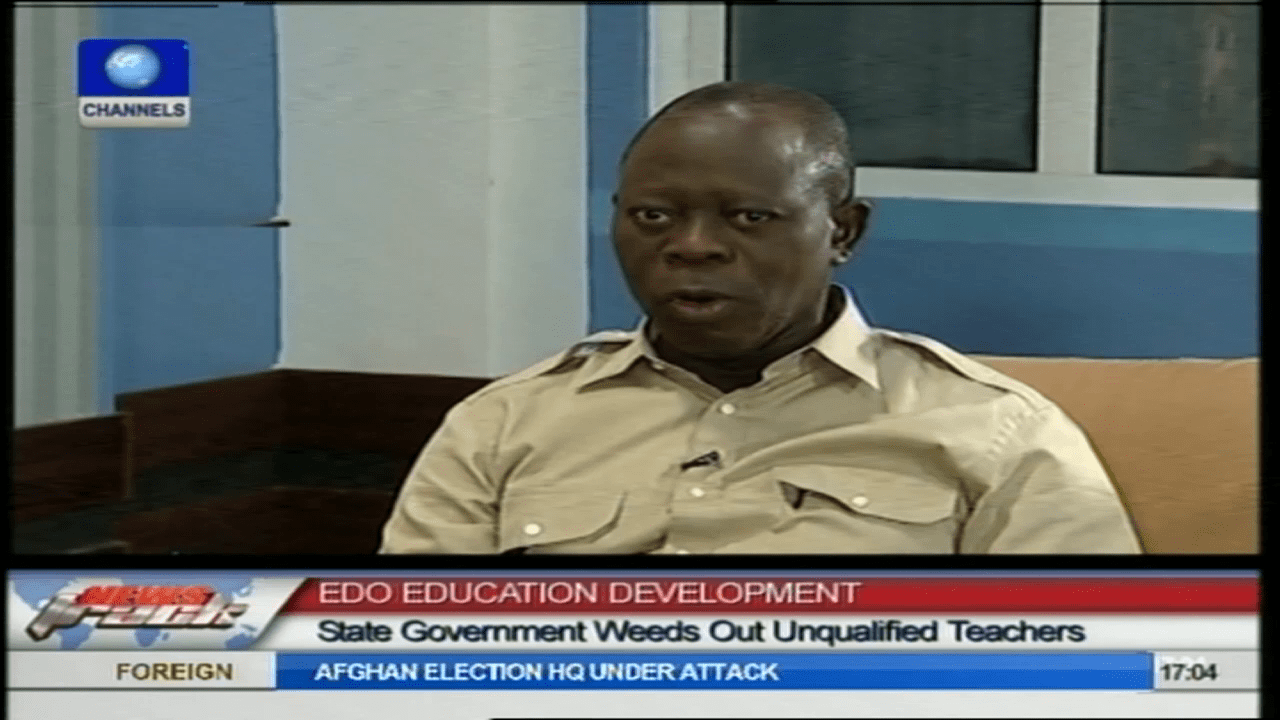
Plan To Weed Out..............
“Edo State government will not retain in its employment anyone whose suitability in a classroom has not been ascertained” adding that “I have taken steps to assemble professors of education; various aspects of education from University of Benin and have asked them to handle this issue professionally” he said.
The decision, according to him, was reached after his one-on-one experience with public school teachers betrayed the low level of knowledge they impact on their students.
The governor also added that it is not enough for anyone who claims to be a professional in the area to have only the basic qualification required. He however said not all teachers who fail to pass the state competency test will be asked to leave, as there are some categories who require additional training.
Sunday, 28 September 2014
Assassination fears........................
Ekiti: Assassination fears grip politicians
September 28, 2014 by Femi Makinde, Kamarudeen Ogundele, Adelani Adepegba and Bayo Akinloye 97 Comments
Fayemi and Fayose
Politicians
in Ekiti State are worried that more assassinations might take place in
the state following the killing of a former Chairman of the National
Union of Road Transport Workers, Omolafe Aderiye, on Thursday.
Aderiye, a stalwart of the Peoples
Democratic Party and a supporter of the state’s incoming governor, Ayo
Fayose, was shot dead by unknown gunmen in Ado-Ekiti, the state capital,
Ekiti State.
His assassination had been preceded by
the disruption of the sitting of the state election petitions tribunal
by thugs believed to be working for Mr. Fayose.
A day after his assassination, on Friday,
the dispute between members of two parties took a turn for the worse
when suspected thugs went round the capital setting buildings and
vehicles ablaze.
To avert further bloodshed, the Ekiti
State Governor, Dr. Kayode Fayemi, quickly declared a dusk-to-dawn
curfew in the state on Friday. In a live broadcast in Ado-Ekiti on
Friday, Fayemi said there would be no movement between the hours of 7:00
p.m. and 7:00 a.m. every day till further notice.
However, politicians in the state, who
spoke to SUNDAY PUNCH on Friday, expressed fears that Aderiye’s murder
might be a sign of things to come.
According to them, the state has a
history of political killings and if the outbreak of violence was not
quickly nipped in the bud, there may be a repeat of past violent
incidents.
Some of the high profile assassinations
that had taken place in the state in the past included the killings of a
World Bank consultant, Dr. Ayodeji Daramola; an Assistant General
Manager, Finance and Administration of the Power Holding Company of
Nigeria in Kaduna State, Mr. Kehinde Fasuba; Mr. Tunde Omojola, Mrs.
Eunice Omojola and Mr. Yemi Oni.
The state Chairman of the APC, Mr. Jide
Awe, told SUNDAY PUNCH that he had not been to the party secretariat
because he was afraid of being attacked.
“Already tension has been created in the
state and people have to look for safety. When there is tension, you
have to look for safety. I have not been to the party secretariat since
Aderiye was killed. I cannot go there without police protection,” he
said.
Similarly, the Director General of Ayo
Fayose Campaign Organisation, Mr. Dipo Anisulowo, said politicians were
not safe in the state.
“Politicians are not safe. We expect
things to change for better, let the outgoing governor do things the
right way as soon as he can,” he said.
Some of the other politicians who
expressed concerns included a former Deputy Governor of the state, Mr.
Abiodun Aluko, who called on security agencies in the state to beef up
security before the crisis further degenerated.
Aluko, who contested the PDP ticket for
the June governorship poll in the state, said the people of the state
were worried about Adeyeri’s killing.
“Those affected now may want to retaliate
and this would worsen the situation. That is why we are calling on
security agents to be alive to their duties. The state must not be
allowed to be thrown into anarchy,” he said.
Similarly, the Chairman of the Conference
of Nigeria Political Parties, Mr. Tunji Ogunlola, when contacted also
said that the people of the state were afraid.
He said, “With this now, nobody is safe.
The only thing I can say is to appeal to the two parties to allow peace
to reign in the state.
“Everybody concerned should put the
interest of the state and its people at heart. We must desist from
actions capable of causing further problem in the state.”
The governorship candidate of the Accord
Party, Mr. Kole Ajayi, also expressed fears about the future of the
state should the crisis continue unchecked.
He said, “It is quite unfortunate that we
have found ourselves in this kind of situation again. Lives are being
wasted and we must act fast to stop it.
“Human lives are sacred. When violence is
becoming uncontrollable; it can lead to a total breakdown of law and
order. As stakeholders all of us must see ourselves as one people. We
are brothers and we should stop this mindless killing.”
Also, Senator Ayo Arise said all
politicians in the state found Aderiye’s muder worrisome. He said,
“Anything that involves loss of lives get me worried. All politicians in
the state are worried about the situation. It is very unfortunate. I
see no reason why people should begin to kill one another because of
politics. I hope there will be no repeat of such.”
When asked what the Nigeria Police Force
headquarters was doing to contain the situation in Ekiti, the Force
Public Relations Officer, Emmanuel Ojukwu, said the situation had been
brought under control.
According to him, the dusk-to-dawn curfew
imposed on the state has brought the crisis under control. He also
stated that nobody would be invited by the Police High Command.
“We won’t intervene in the state because
the situation there is under control. The commissioner of police is able
to handle the situation and he has brought everything under control,”
he said.
When SUNDAY PUNCH sought the comment of
the Ekiti State Police Command on the matter, the Public Relations
Officer, Mr. Victor Babayemi, said the command was keeping an eye on
turbulent areas in Ado-Ekiti, capital of the state.
Babayemi added that it would be difficult
to arrest the Governor-elect, Ayodele Fayose, because there was no
substantial evidence connecting him with the violence in the state.
He, however, stated that no one was above the law in the state.
“Because of the seriousness of the
situation on ground, we cannot invite or arrest the governor-elect
without substantial evidence. We must have substantive evidence to
arrest any suspect. But, one thing is certain, the state is greater than
anybody and no one is above the law.
“We’re talking to a lot of people. Right
now, we can’t reveal the identity of the people we’re interrogating.
This is because revealing their identity can jeopardise our
investigations,” the police spokesman said.
When asked if the command would ask for
reinforcement from Abuja, Babayemi said there was no immediate need for
assistance from Abuja but noted that such request would be made if
necessary.
ANY HOPE FOR OUR COUNTRY ELECTIONS.....................
Political parties set aside funds for bribery — Jega
INEC Chairman, Professor Attahiru Jega
The Chairman of the Independent National Electoral Commission, Prof. Attahiru Jega, in this interview with NIYI ODEBODE, JOHN ALECHENU and ADE ADESOMOJU, speaks on the commission’s preparations for 2015 elections and other related issues
How prepared
is the Independent National Electoral Commission for the election in
Adamawa State in view of recent attacks in the state?
INEC
is prepared to conduct Adamawa election even as we are mindful of the
security challenges. I’m pleased to say that the reports I have been
receiving from our resident electoral officers show that things are on
course. Two days ago, the report I received was that in many of those
areas, people who had been displaced were going back. In about five
local governments, stakeholders that were meeting with the INEC agreed
that we could not distribute the permanent voter cards as we had planned
to do. In those five local governments, it was concluded that voters
would use their temporary voter cards for the election.
Apart
from that, we are encouraged that things are normalising and we will be
able to conduct a credible election in Adamawa. We are not resting on
our oars; we keep monitoring the security situation and we keep
receiving and putting into consideration security analysis and reports
in the state.
Are there special arrangements for the North-East?
I
have said consistently that as an election management body, we are
preparing for the 2015 general elections with a view that elections will
take place everywhere in this country and we are hopeful and prayerful.
I believe many Nigerians are hopeful and prayerful that things will
stabilise and security challenges will not prevent the conduct of
election in any of these states.
As I
said earlier, the spate of attacks in certain cities in the North-East
in the last few weeks gives us additional concern. From the information
we got, many of the displaced people are back, trying to settle down. We
are hoping that in the North-East, by February, there will be
sufficient return of normalcy such that there will be no substantial
risk in the conduct of elections. We are working very closely with
security agencies to plan on how to provide security and how to ensure
that nobody is put at risk. Certainly, we will not do anything to put
our staff, personnel, materials or even the voters at risk. We are
always mindful of security challenges and how disruptive these could be
in an election. But we should also be mindful of the fact that elections
have taken place in places with more serious security challenges than
we are having in the North-East. We shouldn’t give up hope. It’s too
early for anybody to say elections will not take place in the
North-East.
On many
occasions, insurgents strike unhindered where soldiers are absent.
During elections it can be difficult to deploy security men in all the
nooks and crannies of a state. Under this circumstance will INEC still
conduct election?
Again,
we should understand the nature of insurgency. It is to cause fear. It
is to cause terror and it is to create the impression that everything is
unsafe. But our security agencies are doing their best. Elections have
been conducted in Iraq; elections have been conducted in Iran; there are
more serious terrorist activities in those places. I am saying that it
is possible to conduct elections in these places and we are preparing to
explore that possibility.
What
arrangements are you putting in place to safeguard the lives of your ad
hoc staff, particularly the members of the National Youth Service
Corps?
Since the 2011
elections and the unfortunate post-election violence, we have been
working closely with security agencies to pay particular attention to
providing adequate security for the young men and women of the NYSC and
for all members of staff who are involved in electoral duties. Some of
these arrangements are what translated into what happened in Ekiti, what
happened in Osun and even in Anambra. We are putting many measures in
place because we cannot play with the lives of our staff. We have an
inter-agency consultative committee on election security and this
committee has been meeting regularly and we have been reviewing,
analysing, planning and strategising on how to address security
challenges.
Why do elections appear more expensive in Nigeria than elsewhere?
This
is a matter of perception. Elections are not more expensive in Nigeria
than in other African countries. If you look at the key index of
measuring the cost of election which is called the cost of election per
voter, divide the total electoral budget with the total number of
registered voters, like you do for Gross Domestic Product per capita and
you will arrive at how much it costs per voter in the election budget.
If you use that, Nigeria is actually on the average in African
countries, not to talk of globally. It is not expensive. The only
problem is that Nigeria has size; the funds required to conduct
elections in Nigeria is huge. It can’t be compared with that of Ghana,
Kenya or Ivory Coast. But if you divide the cost of election in Kenya by
number of voters, and in Ghana by number of voters and compare it with
Nigeria, their costs are higher than that of Nigeria. The problem here
is that people have a perception when they see the huge figure. But in
every country, election is an expensive affair because you want to
conduct credible elections using international standards and benchmark.
Let
me give you an example of how prudent we are and how unfortunately we
are not meeting international benchmarks in the conduct of elections. On
average, if you look at African countries, or globally, the number of
ad hoc staff or temporary workers in a polling unit is seven. In fact,
some countries put up to 10 so that for every activity in the polling
unit there is somebody supervising it. We have gone all over the world
observing elections — somebody is at the gate managing the queue,
somebody is inside giving ballot papers, somebody is putting ink on
voters’ fingers, somebody is just standing to ensure that the voter does
not put the ballot paper in a wrong ballot box. On average, they put
seven persons in each polling unit. How many did we use in 2011? We used
three. We want to now come close to the average and we want to use six
in 2015, but because of budgetary constraint, we are trying to use four.
We are improving, we used three in 2011 and now we plan to use four.
But we are still far from the average of seven.
How much is it in Nigeria?
In
2011, it was just about $11 per voter. Hence, what we prepared for 2015
in our budget is just about $10.04. That is the cost we are using. Look
at Kenya, the cost of their last election was almost $17 per voter; in
Ghana the cost of their last election was more than $12 per voter. But
because Nigeria is huge and conducting election in Ghana is probably
just a few states put together in Nigeria. When people see the huge
amount of money, they say it’s expensive, but it is not expensive given
what needs to be done.
In
2011 when you acquired some equipment with certain life span, you
complained about storage facilities. Has the challenge been tackled
ahead of the 2015 elections?
We
have done our best to manage what we have, to conduct a successful
exercise and to minimise the cost so that if we have to procure
equipment again, it will have to be for Continuous Voter Registration,
not massive registration. As I speak with you, we have already done CVR
in 22 states and the FCT. What remains is the balance of 12 states which
we hope to do in late October and early November. We wanted to do it
earlier but because we have to conduct the Adamawa election.
Why is the INEC unable to enforce the provisions of the Electoral Act on campaign finance and campaign activities?
The
law provides that you monitor the expenditure of a candidate and the
expenditure of a political party with regard to a particular election.
We have to be careful, because if an organisation is conducting what
seems to be a campaign, when actually parties have not actually
identified who their candidates are, is that something INEC should
monitor? The law didn’t say we should monitor it. There is no candidate
as of now. But sometimes, we are blamed unjustifiably without people
really understanding what the law says we should do. By the time
candidates are nominated and every political party brings its
candidates, then we will monitor how much a candidate spends and how
much the party spends. And we should be able at that time to come out
publicly and announce that this candidate has spent this much, this
party has spent this much for campaign. But again, the law, in some
provisions, is really ambiguous. There is fundamental need for a review
of many of those provisions. For instance, look at the money it says
candidates should spend – it says governors should not spend more than
N100m. Everybody knows that governors really spend much more than that.
Even a local government chairman spends much more than what the law says
a governor should spend. But there is no capacity for monitoring — at
least now.
Are you saying the law is silent on the campaign finances of aspirants?
Yes, the law does not even recognise aspirants. The law only talks about candidates and political parties.
What about campaign activities? There are many who campaign earlier than the time stipulated by the Electoral Act?
That
is the issue. Again, the law has some relative ambiguity about what is
the definition of a campaign? What constitutes a campaign. If you follow
the provisions of the law and you try to extrapolate, a campaign is
when a candidate emerges and the candidate says, ‘I am standing for this
office, vote me for this office,’ or when somebody on behalf of that
candidate says, ‘vote him for this office.’ But look at what is
happening — there is relative ambiguity. Somebody will say on behalf of
somebody, that the person is the saviour for 2015. It’s very ambiguous
and some people are cleverly circumventing the provisions of the law and
they have not committed any offence. What we need to do is to sanitise
that. The commission and political parties have agreed there is the need
for INEC to come out with clear guidelines. As I speak with you, we
have finalised the draft guidelines. By the last week of September, we
are going to hold our regular quarterly meeting with the chairmen and
secretaries of political parties. It is on the agenda; we are going to
discuss the draft guidelines so that we finalise it in good time before
parties do their primaries and candidates emerge. Then, we can sanitise
the campaign process.
Again, the law
is ambiguous with regards to campaign. Some provisions say if you
campaign when you are not supposed to, which is outside 90 days before
election, it is an offence. But in some cases, it does not define what
the penalty for that offence is. The ambiguity needs to be clarified but
unfortunately INEC cannot do that because it is a matter of an existing
law. It means the law has to be reviewed. What I am saying is that
people need to understand that we work under constraints and challenges.
We can only do what the law enables us to do clearly and unambiguously.
One
aspect of the report on the 2011 elections was that there was voter
apathy. There seems to be buck-passing between the INEC and political
parties on whose role it is. What is INEC doing about voter apathy?
Nobody
will contest the fact that in Nigeria, we have a large number of
illiterate voters. There are also people who are apathetic and
indifferent to the political process. Therefore, voter education is very
important and crucial in deepening democracy. The law mandates INEC to
do voter education. In every budget, we have funds allocated to voter
education but unfortunately a lot more needs to be done in voter
education than we have funds to do. The good news is that as we prepare
for the 2015 elections, we have increased the budget for voter education
and we have revised our communication. We even have a new communication
policy which defines how INEC should engage with voters, with different
stakeholders and other constituencies and how we can engage and relate
with civil society organisations and make our voter education campaign
effective. In fact, as I speak with you, we have started implementing
that strategy. We have now established in every state of the federation
what we call Inter-Agency Committee on Voter Education, bringing
different categories of government agencies and stakeholders to do
effective voter education. Development partners also now recognise the
need to fund voter education and make it more effective and they are
contributing a lot of resources through the joint donor basket fund to
do those aspects of voter education that INEC cannot do because of
limited funds.
But the fact of the
matter is that voter education is a collective responsibility.
Unfortunately, political parties sit back and expect INEC to do all the
voter education. Political parties are the ones who field candidates and
who want their candidates to be elected. They want people, first of
all, to come out to vote and when they vote, you want them to vote for
their candidate. Parties also want them to know how to vote; otherwise
they will waste their ballots. Therefore, political parties have an
important responsibility to ensure that whoever comes to vote is
enlightened and in fact, people are enlightened enough to come out to
vote and then to vote correctly. But parties are sitting back, saying
‘INEC, you haven’t done enough voter education.’ Even in voter
registration, it may interest you to know that some parties are asking
INEC for money with which to do voter education for people to come out
for registration. These are important responsibilities they have and
they have to pay attention to them. For example, every party must have a
budget devoted to voter education and sensitisation because these are
linked to their campaigns, for people to vote for their candidates. Do
they do that? But they will vote money for bribing electoral officials.
Do they do that (bribing electoral officials)?
They
used to do that, but I am hoping that they no longer do that because
they can see it doesn’t work and we have the capacity now in INEC to
quickly identify, apprehend and punish whoever allows himself or herself
to be induced. It used to be a common thing that the first item on the
budgetary agenda of a political party in Nigeria was money to be
distributed; but the priority for parties in their budgeting should be
voter education and sensitisation. It is very important.
How
will you contain the alleged excesses of security operatives in the
2015 elections in view of allegations that they intimidated opposition
party loyalists in Osun and Ekiti; that ministers also used their
offices to do the same and that security operatives prevented INEC from
announcing the results in Osun until there was a protest by voters?
There
are several issues lumped together in that questions. I will attempt to
see if I can separate them. First and foremost, there are systemic
security challenges and INEC is not a security organisation. We are an
election management body and we want election to be peaceful. We want
voters to feel secure to come out and vote. We want our workers to feel
protected and the materials too, in order to do their job without fear
of intimidation or assault. In Nigerian election, we must recognise that
security is important and security agencies have a role.
People
have been talking about massive mobilisation of security in Ekiti and
Osun and they have even alleged that voters were disenfranchised. The
evidence does not support that allegation. In Ekiti, at the time we did
the election, the voter turnout in Ekiti was about 53 per cent. That was
the highest voter turnout for any governorship election up to that
time. In fact, the highest until then was barely 30 per cent. How can
you say voters have been disenfranchised? If anything, what the evidence
suggested was that the presence of security made voters comfortable to
come out and exercise their duties. By the time we conducted the
governorship election in Osun, the percentage of turnout was higher than
that of Ekiti; it was about 57 per cent. It even came close to
presidential election turnout. Hence, the evidence suggests presence of
security provides assurance for voters that they may not be assaulted by
partisan thugs and that they can discharge their civic
responsibilities. I think we need people to recognise this.
Then
people talk about militarisation. Yes, the military is present. But the
role of the military has been carefully defined. The military does not
go to polling units; the military does not do in-town patrols. What they
do is called outer peripheral cordon — entrances to the cities and
checkpoints. And when there is crisis or civil disturbance which the
mobile police cannot quell, the military is invited to do that. In both
Ekiti and Osun, that is what they did. In fact, when you talk about
militarisation, I laugh. I am a political scientist I know it was not
militarisation. The police deployed at least 15,000 or more in Ekiti and
Osun. But it is important because we need an average of three policemen
or a combination with other security operatives per polling unit. Thus,
the numbers are huge. But the military deployed barely 1,000 personnel
in both Ekiti and Osun. All these talks about militarisation are just
perception.
Sometimes, some
politicians who don’t want the security presence because they can stop
them from doing what they have planned to do in election will talk about
militarisation. A lot of what people talk about security in elections,
frankly, is politics. It is politics and it is over-exaggerated.
Will INEC allow the use of masked security men in the 2015 elections?
That
is another issue. I don’t want to generate unnecessary controversy. But
we have engaged the security agencies and we have conveyed our feeling
that on election day, every security personnel needs to be identifiable.
That it is why we expect that if it is a policeman or a soldier or
whoever, he will have a number and a name tag because everything about
election is about transparency and credibility. Otherwise, some
miscreants can also start covering their faces and doing things under
cover.
The newly created
polling units have generated a lot of controversies. Some have said you
should have just created additional polling points in the existing
polling units instead of creating new polling units.
We
have been reforming INEC since 2011 and we have been saying the 2015
elections will be remarkably much better than that of 2011. We need to
keep on improving the reforms that can add to the integrity, the
efficiency and the effectiveness with which we conduct elections. We
used voting points as temporary measures to decongest polling units but
they are not a substitute to having substantive polling units. We have
been using a temporary measure for almost four years and we think it is
time now to create polling units and to ensure that every voter now
knows which polling unit he or she belongs to. We have been
unjustifiably criticised for doing that. We believe strongly that those
who criticised our position probably didn’t have the necessary
information. We are putting out all the information, engaging
stakeholders and making people recognise that what we are trying to do
is patriotic. It is in the interest of this country and it is supposed
to help the voters and ease their difficulties on voting day.
What is the relevance of the new national identity card to elections? Will it be used in 2015?
The
national identity card that is being produced and distributed now has
no relevance to the election in 2015. But it is important for us to
understand that the reason why INEC is given the responsibility to
produce voter cards is because in Nigeria, we don’t have national
identity cards. In most countries, in fact, in all countries that have
national identity cards, you do not require another voter card to vote.
The national identity card is used because it identifies that one has a
unique number and is used for the purposes of election. Our hope in INEC
actually, is that by 2019 general elections, once the national ID card
system has become well established, there may be no need to spend money
to produce Permanent Voter Cards. All we will do in INEC is to go to the
national identity card database, that anybody who is 18 years and above
can be taken and then they can now just indicate that they want to be
registered as voters. Once they do that, we will put them on the
register and then on the election day, they can use their national
identity cards for voting. The national identity card, just like the
INEC card, is biometric. You can use the card readers with the national
identity cards.
What
measures is INEC putting in place to address the concerns of people over
the Continuous Voter Registration exercise and distribution of the
Permanent Voter Cards?
Frankly,
if you look at the statistics, you will discover that people are making
a mountain out of a molehill — you know our politicians. A lot of that
hullaballoo on registration is caused by people doing multiple
registrations. People who are already registered, who are already in our
database are being mobilised again by politicians to register. You see
long queues and once you are in the queue, we have to attend to you. We
waste money, we waste time, because eventually we will remove your name
and you will be on our list of electoral offenders for doing multiple
registration. If you look at the statistics of distribution of the
cards, by the time we did the distribution in the second phase of 12
states, the average distribution was about 67 per cent of the registered
voters that came out within that period of three days to collect their
cards. We have taken the remaining cards back to the local government
offices and people have between now and December or even January to go
to the local government offices to pick their card. People are just
criticising us for nothing.
Don’t
you think the perception that INEC, subjectively, allocated more
polling units to the North arose because the commission did not do
enough consultation?
You
can never do enough consultation. We cannot be accused of not doing
consultation but people are saying we have not done enough consultation.
You can never exhaust the scope of consultation and engagement. We have
done our best, unfortunately, our best was not good enough. Hence,
there were still misunderstandings.
Unfortunately,
some mischief makers, I’m sorry I have to say it, may have latched onto
the ignorance of many people and mobilised all sorts of sentiments
especially regional sentiments on this matter. But we know that we have
done this to the best of our ability and our conscience is clear. We
haven’t done it with any agenda and we believe whoever sees the
information we are passing will recognise that there is no hidden agenda
in this and that the primary objective is to make it easier for a voter
to vote.
In INEC currently, we have a
register of whoever has registered; we have removed duplicates. It’s
clean; it’s called post-AFIS register. There is no way a polling unit
can have anybody outside of people that have already registered. All we
did was to take each state and say, ‘What is the total number of total
registered voters?’ If we are to divide the polling units into a maximum
of 500 voters each, how many polling units should this state get and
what is the existing number of polling units? What is the difference
between the existing number and the requirement if it is divided into
500 voters? And then we said in addition to doing this, we also
recognise that in every state or major urban centres, there are new
settlements, where there are no polling units. We give 15 per cent of
the total number of polling units we are distributing so that every
state will have at least 121 additional polling units. That is what
we’ve done and it’s very clear.
We have provided the information and let anybody look at that and see whether what we are being accused of is true.
Oshiomhole wants monarchs to tackle oil theft
September 28, 2014 by Alexander Oker
Edo
State Governor, Adams Oshiomhole has called on traditional rulers in
oil-producing states of the federation to speak up against crude oil
theft and identify the perpetrators of the heinous crime in the interest
of the country.
Governor Oshiomhole, who made this known while playing host to
monarchs from the South-South geo-political zone at the Government House in Benin, decried the level of environmental degradation in the region and the huge loss of resources incurred by the government as a result of the operations of illegal refineries.
While lamenting that the nation’s wealth was being dislodged by a few unscrupulous individuals, who did not appreciate and believe in the principle of hardwork, the governor urged the monarchs to assist in checking the menace in the region.
Oshiomhole said, “I think Your Royal Majesties have a role to play to lend your voice against oil theft because it is destabilizing the country and creating huge environmental challenges, which we will confront when we may not have the resources to do so.
“When the oil dries up when it will dry up, the damage already done to the environment will persist and the resources that will be required to regenerate the environment to deal with the consequences of the pollution may not be available.
“Across the South-South, too many of our people who want quick money are involved in crude oil theft. In Edo State, around Agbede, it’s not an oil producing area but for some strange reasons, there are all kinds of illegal refineries there polluting and destroying a place that is ordinarily very suitable for agriculture.
“Being in government, there are things I no longer can say. But that does not mean that those things are not in my heart. I am worried about what appears to be a free hand for criminals to help themselves with our common patrimony called oil and gas.
“One of the long term consequences of this kind of situation is that you have small-small boys of very little exposure, having access to huge resources that is not the result of hard work. And because they are criminal in nature, and the volume and sum involved is huge, they have enough money to raise an alternative army to procure the deadliest weapons in order to defend their territory, which is basically an area they have carved out for the purpose of that heinous crime.”
“I am very worried about the future of our country if few people take so much and the rest of us in the country have so little to share and these people are not invisible. If the volume of oil smuggling is so much and you know the amount, it means you should know the smugglers.
“Nigeria must find the courage to speak truth to power, including traditional power and if any of us, president, governor, minister or traditional ruler fouls the atmosphere, we should be dealt with according to law. Nigeria is greater than any of his sons.”
On local government administration, Oshimhole advocated new reforms to make local governments more responsible, adding that “most of the local government reforms are the outcome of ill-digested military solution to far more complex problems.”
Earlier, the Chairman of the South-South Monarchs Forum, HRM, Edmund Daukoru, while explaining that the monarchs were in Benin to hold a meeting and present copies of the book launched by the forum at its conference.
He said,“Our institution is one that can effectively partner with government to penetrate down to the grassroots level and we can’t do that if we stay in our respective palaces. If we never get to meet, we never get to exchange ideas.”
Governor Oshiomhole, who made this known while playing host to
monarchs from the South-South geo-political zone at the Government House in Benin, decried the level of environmental degradation in the region and the huge loss of resources incurred by the government as a result of the operations of illegal refineries.
While lamenting that the nation’s wealth was being dislodged by a few unscrupulous individuals, who did not appreciate and believe in the principle of hardwork, the governor urged the monarchs to assist in checking the menace in the region.
Oshiomhole said, “I think Your Royal Majesties have a role to play to lend your voice against oil theft because it is destabilizing the country and creating huge environmental challenges, which we will confront when we may not have the resources to do so.
“When the oil dries up when it will dry up, the damage already done to the environment will persist and the resources that will be required to regenerate the environment to deal with the consequences of the pollution may not be available.
“Across the South-South, too many of our people who want quick money are involved in crude oil theft. In Edo State, around Agbede, it’s not an oil producing area but for some strange reasons, there are all kinds of illegal refineries there polluting and destroying a place that is ordinarily very suitable for agriculture.
“Being in government, there are things I no longer can say. But that does not mean that those things are not in my heart. I am worried about what appears to be a free hand for criminals to help themselves with our common patrimony called oil and gas.
“One of the long term consequences of this kind of situation is that you have small-small boys of very little exposure, having access to huge resources that is not the result of hard work. And because they are criminal in nature, and the volume and sum involved is huge, they have enough money to raise an alternative army to procure the deadliest weapons in order to defend their territory, which is basically an area they have carved out for the purpose of that heinous crime.”
“I am very worried about the future of our country if few people take so much and the rest of us in the country have so little to share and these people are not invisible. If the volume of oil smuggling is so much and you know the amount, it means you should know the smugglers.
“Nigeria must find the courage to speak truth to power, including traditional power and if any of us, president, governor, minister or traditional ruler fouls the atmosphere, we should be dealt with according to law. Nigeria is greater than any of his sons.”
On local government administration, Oshimhole advocated new reforms to make local governments more responsible, adding that “most of the local government reforms are the outcome of ill-digested military solution to far more complex problems.”
Earlier, the Chairman of the South-South Monarchs Forum, HRM, Edmund Daukoru, while explaining that the monarchs were in Benin to hold a meeting and present copies of the book launched by the forum at its conference.
He said,“Our institution is one that can effectively partner with government to penetrate down to the grassroots level and we can’t do that if we stay in our respective palaces. If we never get to meet, we never get to exchange ideas.”
Subscribe to:
Posts (Atom)